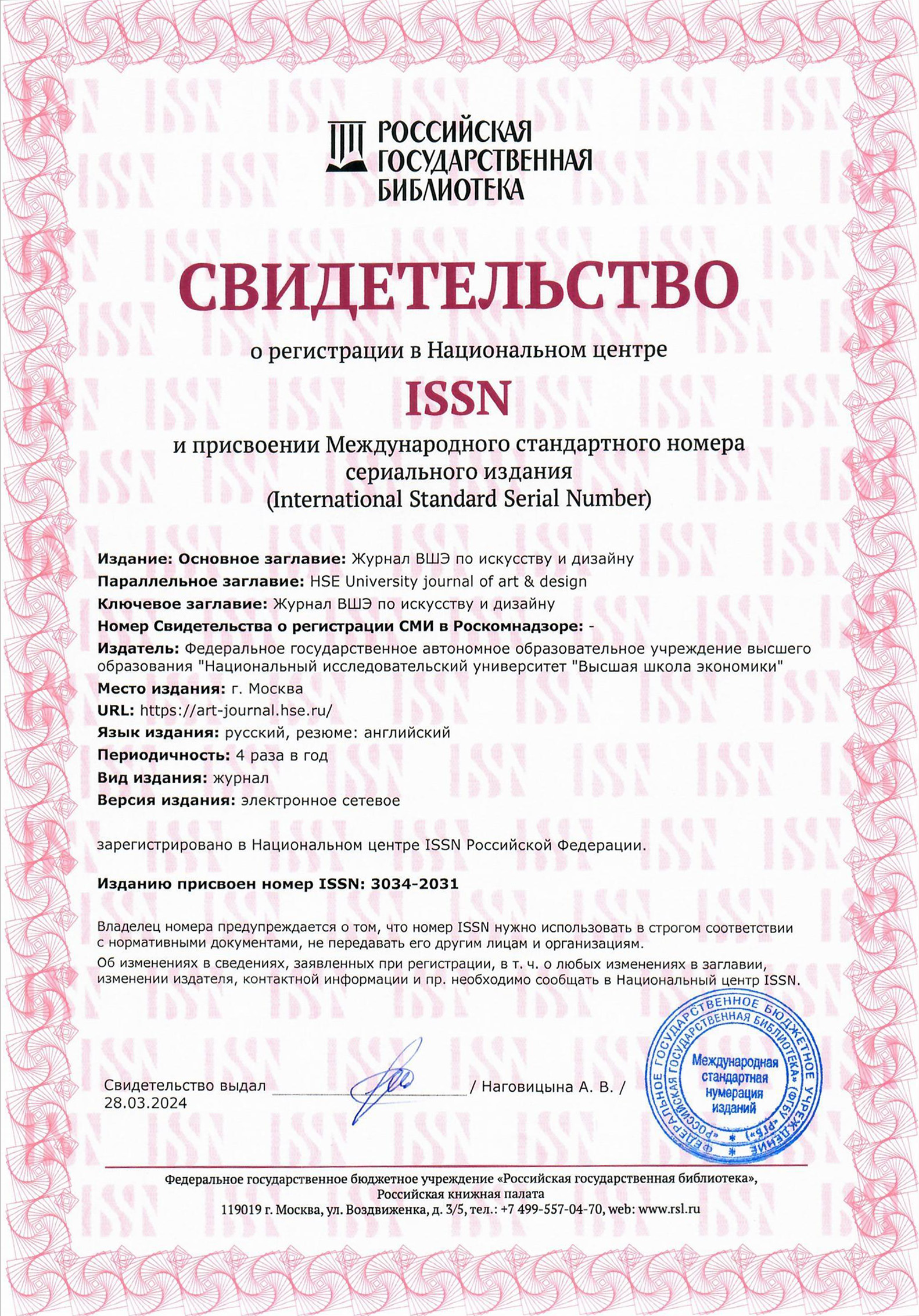
HSE University Journal of Art & Design is an online academic journal published by the HSE Art and Design School at the Faculty of Creative Industries, HSE University. The journal has been published quarterly since 2024.
HSE University Journal of Art & Design is a unique publication that captures the “visual lexicon” of specific historical eras alongside original research. The journal’s content focuses on art history and cultural studies, emphasizing integrative research and under-explored issues that have long remained on the margins of fundamental art texts. We approach the classics as a vibrant, living project, incorporating methodologies from Visual Studies and the New Art History to view art through a new lens and a panoramic perspective. Design theory and practice are central to the journal, including new vectors in Practice as Research and the development of new research tools in the design field. We operate within a space of methodological synthesis and hybrid research fields, including Art & Science, Ecological Art & Design, Art & Economics: creative industries etc.
We collaborate with leading specialists from Russia’s academic institutions, including the The State Institute for Art Studies of the Ministry of Culture of the Russian Federation, the A.M. Gorky Institute of World Literature of the Russian Academy of Sciences, and the Research Institute of Theory and History of Fine Arts of the Russian Academy of Arts. We also work closely with professors and researchers in art, design, and related humanities disciplines at the HSE University and other leading universities across the Russian Federation. An important role is played by representatives of major museum institutions in Moscow and St. Petersburg, who provide access to archival holdings and collections for research and subsequent publications.
We pursue an innovative publishing strategy, seeking within a single issue to present a broad spectrum of “tectonic shifts” in scholarship and to showcase diverse experimental practices in art and design, both in Russia and abroad. This original academic publication not only brings together the best traditions of Russian and international journals, but also marks a new stage in the development of research strategies in the field of art and design, while serving as a cultural and educational project. The high academic standard of the publication is ensured by the Editorial Board, which includes leading representatives of contemporary art-historical scholarship in Russia and abroad, as well as invited specialists in art history, design, cultural studies, philosophy, and other related humanities disciplines.
The journal is a periodic publication released quarterly (4 issues per year). Each issue contains 7–10 articles (approx. 20,000–40,000 characters each), totaling 20–25 author's sheets. Languages: Russian and English. All scientific articles undergo double-blind peer review, ensuring the anonymity of both author and reviewer. Reviewers are experts appointed by the Editorial Board from a database of internal and external specialists. Issues are not restricted to specific thematic constraints but follow a clear structure: Editorial, Articles, Book Reviews (Academic Overview), International Humanities (translations), and Conference Announcements. The website provides submission guidelines, the list of Editorial Board members, review procedures, and ethical standards. A journal archive is also available. All articles are accessible online and as PDFs, with an option to download the full issue. The website design and high-resolution illustrations are integral parts of the publication's identity and quality.
Chairman of the advisory board
Head of the HSE Art and Design School, designer, artist, founder of one of Russia’s first design studios, Agey Tomesh, and of the publishing house WAM Books.
ORCID: 0000-0003-3205-0574
ResearcherID: K-2343-2015
Doctor of Economics, Co-Founder and Professor at the HSE Art and Design School, Member of the Academic Council of HSE University, Director of the Institute for the Development of Creative Industries. Executive Producer of the Telling Stories Festival.
ORCID: 0000-0002-7673-8947
ResearcherID: L-2580-2015
Scopus AuthorID: 57206778463
Doctor of Philosophy, Candidate of Sciences in Architecture, Professor and Head of the Department of Art and Environmental Design at the Belarusian State University. Visiting Professor at Lomonosov Moscow State University (Moscow), as well as at a number of European and American universities.
ORCID: 0000-0002-7768-2682
Scopus AuthorID: 57189929973
Candidate of Sciences in Architecture, Professor, Corresponding Member of the International Academy of Architecture (IAA). Architectural historian, practicing architect, critic, and regular contributor to TATLIN Publishers.
Professor, until the end of 2017 — Head of the Department of Russian Language and Russian Literature at the University of Naples “L’Orientale” (Università degli Studi di Napoli “L’Orientale”). Author of books and articles on Russian writers, artists, theatre figures, and ballet performers of the 19th and 20th centuries.
Candidate of Sciences in Art History, Deputy Director for Research at the Pushkin State Museum of Fine Arts, Professor at the School of Arts and Cultural Heritage, European University at St. Petersburg.
Candidate of Sciences in Art History, Associate Professor in the Department of Communication Design at the Stroganov Moscow State Academy of Arts and Industry. Illustrator of children’s books, Member of the Moscow Union of Artists. Author of a lecture course on the history of graphic design.
ORCID: 0009-0002-8092-3229
ResearcherID: NAZ-0412-2025
Candidate of Sciences in Art History, Deputy Editor-in-Chief of the journal Iskusstvoznanie, Senior Research Fellow in the Department of Western Classical Art at the State Institute for Art Studies (Ministry of Culture of the Russian Federation). One of the leading specialists in 15th-century Italian book illumination.
Candidate of Sciences in Philology, Associate Professor at the HSE Art and Design School, Director of the Doctoral School in Art and Design at HSE University. Editor-in-Chief of the journal Theory of Fashion: Dress, Body, Culture, published by Novoe Literaturnoe Obozrenie.
ORCID: 0000-0001-7795-2059
ResearcherID: Z-1306-2019
Candidate of Sciences in Art History, Associate Professor at the HSE Art and Design School, Head of the Department of Art History at the HSE Art and Design School, Member of AICA-Russia (International Association of Art Critics). Author of widely attended popular online courses on the history of classical and contemporary art.
ORCID: 0000-0002-2969-2720
ResearcherID: K-4730-2015
Doctor of Sciences in Art History, Associate Professor at the HSE Art and Design School, specialist in contemporary visual culture. Author of more than 40 articles and the monograph Against the Image Industry: Syntopic Projects in the Context of Contemporary Art. Organizer of exhibitions and conferences devoted to art and design.
ORCID: 0000-0002-6754-4235
ResearcherID: Z-2521-2019
Art historian and architecture historian, Senior Lecturer at the HSE Art and Design School, Academic Director of the Environmental Design educational programme, Professor at the Moscow Branch of the International Academy of Architecture (IAA–MAAM), Member of the Union of Moscow Architects. Author of numerous articles on the history of architecture and design.
ORCID: 0000-0002-7525-908X
ResearcherID: Z-0347-2019
Art historian and collector, Curator of the UniCredit Bank Corporate Collection of Twentieth-Century Art (Moscow). Specialist in 20th-century Russian art, Lecturer at the HSE Art and Design School.
Photo by Lena Avdeeva
Doctor of Sciences in Philology, Professor at the HSE Art and Design School, cultural theorist and art historian, researcher of the Russian avant-garde of 1910–1927 with a high level of international citation.
ORCID: 0000-0002-5510-6684
ResearcherID: B-2047-2016
Scopus AuthorID: 57196349789
Doctor of Sciences in Philology, Professor at the HSE Art and Design School, author of scholarly articles, textbooks, instructional and methodological manuals, and monographs on linguistics and the methodology of teaching English.
ORCID: 0000-0002-2122-5896
ResearcherID: K-5099-2015
PhD in Arts and Design, Lecturer in art history and curatorial studies at the HSE Art and Design School, participant in the Place of Art project (Moscow).
ORCID: 0000-0001-8190-8819
ResearcherID: A-1532-2351
Film critic, video essayist, and curator of film programmes. Lecturer in film history and media theory at the HSE Art and Design School. Published on the websites Colta, Spectate, Sense of Cinema, La Furia Umana, and in the Outskirts film magazine, among others.
ORCID: 0000-0033-7275-0744
ResearcherID: A-1665-2022
Head of the Publishing Programme at the HSE Art and Design School. Previously worked at the design studio Agey Tomesh and at the magazine Delovye Lyudi, and has collaborated with numerous book designers. The publications produced under his direction have repeatedly received diplomas and awards in various competitions.
Editor-in-Chief of the HSE Art and Design School. Formerly a journalist, television and radio host, PR director, manager, and producer of various musical projects.
Picture Editor at the HSE Art and Design School. Worked as a photojournalist and picture editor for the magazines SALON Interior, Klassika, Modern Design, Moy Prekrasny Sad, as well as Private Interior. Saint Petersburg among others.
Proofreader at the HSE Art and Design School. Since 2003, she has been involved in the production of all publications issued by the publishing group Agey Tomesh / WAM Books.
Authors should submit manuscripts formatted according to the Journal’s requirements via email to the HSE University Journal of Art & Design at art.journal@hse.ru.
Please submit articles as Word (*.docx) files, accompanied by a brief cover letter requesting publication. Cover Letter Template: “I request that the HSE University Journal of Art & Design consider my article, [Title], for publication. I hereby confirm that I am the author of this text and consent to its review and editing. I confirm that this article is an original research study, has not been published elsewhere (in whole or in part), contains no plagiarism, self-plagiarism, or improper citations, and adheres to all research and professional ethical standards.”
Author Information: Please provide the full name of the author or authors (in Russian and English), academic degree, title, position, and place of work/study without abbreviations (listing the correct institutional affiliation). Include your email address and contact phone number. Authors will receive a specific form to complete these details.
All submissions undergo a mandatory plagiarism check. If plagiarism is detected, the manuscript will be rejected, and the author will be added to the Journal’s blacklist, prohibiting future submissions.
All articles undergo external and internal double-blind peer review. If reviews are negative, the article will be rejected, and the Editorial Board will not enter into further correspondence. If reviewers recommend publication subject to revisions, the author has two weeks to make the necessary changes. Failure to meet deadlines or ignoring reviewer recommendations may result in formal rejection. The Board may reject a submission if the content does not align with the Journal’s scope or themes, lacks scholarly depth, contains falsified data, or violates ethical standards in polemical discourse. Upon a positive review, the Editorial Board makes the final decision. Accepted articles proceed to scientific editing, proofreading, and layout. The author will be notified of the publication timeline. There are no publication fees.
The Editorial Board is committed to protecting all personal data, ensuring it is not shared with third parties and is used solely for academic publication purposes.
The Board requests that authors disclose any potential conflicts of interest and guarantees that the review process remains free from contentious or conflicting situations.
All publications are available via Open Access in online and PDF formats. Issues and individual articles may be read and downloaded, provided the author and the original publication in the HSE University Journal of Art & Design are cited. All copyright laws are observed. Authors agree not to publish materials in open online sources, social networks, or professional platforms prior to the article’s release in the Journal. Authors grant the right to republish the work in the print version of ART, which serves as a printed supplement to the academic journal. The Editors pledge to respect all copyright agreements upon receiving author consent. Authors are strictly responsible for securing permission to publish visual materials, including works held by museums or artists protected by copyright.
The Editorial Board accepts digital submissions in Microsoft Word (.docx) format.
Text length: 20,000–40,000 characters (including spaces).
Font: Palatino Linotype, 12 pt.
Spacing: Single line spacing.
Paragraph indentation: 0.5 cm.
Margins: Top/Bottom: 2 cm; Left: 2.5 cm; Right: 1.5 cm.
Alignment: Justified (Abstract, Keywords, Main Text, and Bibliography).
Hyphenation: Automatic.
Page numbering: None.
Article Title: 14 pt, centered.
Author(s) Full Name: separated from the title by one empty line; bold, 12 pt, centered.
Affiliation: Full name of the institution (workplace or university) and mailing address (including zip code, country, and city).
E-mail: 11 pt, centered.
Abstract
Length: 1,500–2,000 characters (including spaces). Separated from the previous section by one empty line. Font size: 11 pt, justified alignment. The abstract serves as a concise summary of the research, highlighting its key theoretical concepts or practical results. It must outline the most significant arguments and the research trajectory. Clearly define the objectives, goals, and methodology without using citations. The text must be logical, structured, and accurately reflect the content of the article.
Keywords
Length: 5–12 words or phrases. Separated from the abstract by one empty line. Font size: 11 pt, justified alignment. Keywords act as primary content markers, defining the field of study and the article’s subject matter. List them in order of importance and relevance.
In-text citations are placed within the text in square brackets following this format: [Bart, 2020, p. 58], where “Bart” is the author’s last name, “2020” is the year of publication, and “58” is the page number. If necessary, multiple pages may be cited; in such cases, use an en dash to separate page numbers. All citations must correspond to entries in the bibliography and be cited at least once. Self-citation is permitted where necessary. Citing print editions is preferred over electronic resources whenever a printed version is available.
Any emphasis added within a quote must be noted in parentheses (e.g., “italics mine. – I.M.”), where “I.M.”represents the author’s initials (italicized). If a portion of the text is omitted within a quote, use an ellipsis. If a complete phrase is omitted, use an ellipsis enclosed in angle brackets: <…>. Such abbreviations must not distort the original meaning of the text.
Grant details appear in a footnote on the first page, immediately following the author’s name. Do not use the “No.” symbol. Project titles are optional and should be placed in quotation marks after the project number. For example: The article was prepared with the support of the RFBR, project 15-04-00005a “Verbal & Visual: The Grammar of Poetic Culture.”
Acknowledgments (in bold type) follow the main text.
Notes are formatted as footnotes located at the bottom of each page. A footnote is marked in the text with a superscript number. Numbering is continuous throughout the document. Use font size 10 and justified alignment.
All illustrations, graphs, and tables must be placed within the text where contextually appropriate (not at the end of the document). They must be referenced in the text using the format “(Ill. 1)” and include a caption following this structure: Ill. 1. First Name Last Name. Title. Year. Medium. Dimensions. Museum, City.
Example:
Ill. 1. Anselm Kiefer. Varus. 1976. Oil, acrylic. 200 × 270 cm. Van Abbemuseum, Eindhoven
Captions must be set in font size 11. Do not include URLs in the in-text captions; full citations are provided in the List of Illustrations.
Digital files for illustrations and photographs must be sent separately, numbered to correspond with their placement in the text (Ill. 1, Ill. 2). Files must be in JPG format, with a resolution of at least 300 dpi and a maximum file size of 5 MB. A List of Illustrations must appear at the end of the bibliography in both Russian and English, including the source and date accessed. When reproducing illustrations from a print edition, provide a full bibliographic description including the page number.
Example:
List of Illustrations
Ill. 1. Anselm Kiefer. Varus. 1976. Oil, acrylic. 200 × 270 cm. Van Abbemuseum, Eindhoven. Image source: URL: https://vanabbemuseum.nl/en/collection/details/collection/ (accessed: 02.22.2023)
Ill. 2. Yi Jing. Mountains and Waters. 17th century. Silk, gold paint. 87.8 × 61.2 cm. National Museum of Korea, Seoul. Image source: Official museum website. URL: https://www.museum.go.kr/site/main/relic/search/view?relicId=8490 (accessed: 02.23.2023)
Ill. 3. Roof plan of the Elektroperedacha Power Plant (Fabrikanlage bei Moskau). Architect: H. Muthesius. June 20, 1912. Image source: Technical Archive of PJSC Mosenergo. URL: https://www.mosenergo-museum.ru/ (accessed: 02.24.2023)
Ill. 4. Francis Gruber. Job. 1944. Oil on canvas. 162 × 123 cm. Tate, London. Image source: Official Tate Gallery website. URL: https://www.tate.org.uk/art/artworks/gruber-job-t00180 (accessed: 04.10.2023)
We recommend thoroughly verifying the copyright status of all illustrative material for open-access publication in compliance with Article 1274 of the Civil Code of the Russian Federation. All questions regarding the use of visual material should be directed to Olga Doroshchenkova, Picture Editor and Copyright Manager of the HSE Art and Design Journal. Contact: odoroshchenkova@hse.ru.
If the author’s research relies on historical sources or cultural monuments (e.g., ancient manuscripts, archival materials, or artifacts directly reflecting key facts and events), a separate section titled “Sources” should be created immediately preceding the Bibliography.
The Bibliography is formatted according to current bibliographic standards in Russian and English. General rules for references and bibliography are defined by the System of Standards on Information, Librarianship, and Publishing (GOST-2008). The bibliography is organized alphabetically and is not numbered. See TEMPLATE 1.
References are formatted according to specific rules. See TEMPLATE 2.
Article Header and Abstract Formatting. Examples:
STS and the Possible Future of the Science Museum:
Towards a New Kunstkammer
Alexander A. Pisarev
Institute of Philosophy, Russian Academy of Sciences, 109240, Russia, Moscow,
12 Goncharnaya St.
topisarev@gmail.com
Abstract
The article analyzes the representation of science in science and technologymuseums and centers, and outlines the possible concept of a museum of technoscience that would compensate their limitations and omissions. In contrast, the museum of technoscience is not dedicated to what scientists know about nature, but to how they get this knowledge, how it exists and is applied, that is, to metascientific issues. To meet this challenge, the new museum should be based on the ideas of Science and Technology Studies (STS), and of the History and Philosophy of Science. It is likely that today the path of reason to maturity should pass not only through scientific education, but also through metascientific education, that is, through STS and the History and Philosophy of Science <...>.
Keywords: science museum, science and technology center, science and technology studies, history of science, society, practical philosophy, public understanding of science, technoscience, technoscience museum.
For citation: Pisarev, A. A. STS and the Possible Future of the Science Museum: Towards a New Kunstkammer // HSE University Journal of Art and Design, 2024, no. 1 (1), pp. 64–78. DOI: 10.23951/2312-7899-2021-4-131-185
Do not use automatic numbering when creating the reference list. The headings “Bibliography” and “References” must be set in 14-point type; the rest of the list must remain in 12-point type (Palatino Linotype).
Sample Formatting
Architecture of the USSR (1963). Problems of Style in Soviet Architecture // Academy of Architecture of the USSR. No. 11, p. 50.
Bloor, M. (2002). The Strong Program in the Sociology of Knowledge // Logos. No. 5–6 (35), pp. 1–24.
Bourdieu, P. (1996). Academic Doxa and Creativity: Against Scholastic Divisions // Socio-Logos’97. Almanac of the Russian-French Center for Sociological Research of the Institute of Sociology of the Russian Academy of Sciences. Moscow: Socio-Logos, pp. 8–31.
Vakhshtayn, V. (2017a). Reassembling the Everyday: Drones, Elevators, and Project PkM-1 //Logos. No. 2, pp. 1–48.
Vakhshtayn, V. (2017b). Experimental Desecration. Cosmogony and Morphology of Enlightener Communities. 13.12. 2017 // Indicator.ru. URL: https://indicator.ru/humanitarian-science/viktorvakhshtayn-slyot-prosvetiteley-2017.htm (20.08. 2021).
Daston, L. and Galison, P. (2018). Objectivity. Moscow: Novoe literaturnoe obozrenie, 2018.
Dean, M. (2016). Governmentality: Power and Rule in Modern Society. Moscow: Delo Publishing House.
Smolyanskaya, N. V. (2009). The Sublime in Interpretations of Postmodern Art: J.-F. Lyotard’s Concept for the Exhibition “Les Immatériaux” // The Philosophy Journal. No. 1, pp. 127–140.
Shapin, S. (2020). How to Be Antiscientific. // Logos. No. 1, pp. 159–185.
Cameron, D. F. (1971). The Museum, a Temple or the Forum. // Curator: The Museum Journal. Vol. 14, no. 1, pp. 11–24.
Daston, L. (ed.) (2000). Biographies of scientific objects. The University of Chicago Press.
Daston, L. (2019). Against Nature. Cambridge, MA: MIT Press.
Haraway, D. (1984–1985). Teddy Bear Patriarchy: Taxidermy in the Garden of Eden. New York City, 1908–1936. // Social Text. Winter 1984–1985. No. 11, pp. 20–64.
Johnson, M. (2019). STEM programs key to winning ‘the new Cold War’, 13.02.2019 // NonDoc. URL: https://nondoc.com/2019/02/13/stemprograms-help-win-new-cold-war/ (accessed 20.08. 2021).
Latour, B. (2000). On the Partial Existence of Existing and Nonexisting Objects // Biographies of scientific objects / Daston, L. (Ed.) The University of Chicago Press, pp. 247–269.
Latour, B. & Weibel, P. (eds.) (2002) Iconoclash, Beyond the Image-Wars in Science, Religion and Art. Cambridge, MA: MIT Press.
Shapin, S. (2016). Invisible Science // The Hedgehog Review. 2016. No. 3. URL: http://scholar.harvard.edu/files/shapin/files/invisible_science_final.pdf (accessed 20.08.2021).
Commentary:
1. In-text citations are placed in square brackets indicating the author, year, and page [Bakhtin, 2003, p. 18].
2. For two authors, cite as [Daston and Galison, 2018, pp. 107–181], or for English sources [Latour & Weibel, 2002, p. 34]. For three or more authors, list the first author followed by "et al." [Petrov et al., 2021, p. 64].
3. Formatting archival documents. Bibliographic references to archival documents must identify the document's specific location (archive, personal collection, museum, library, etc.). Examples: OR RNB, F. 316, D. 161, l. 1; RO IRLI, F. 568, Op. 1, no. 196, l. 18–19v.
4. If citing an online resource within the text, use the following format: [URL: http://www.community.livejournal.com/musei_kino/424668.html].
5. If citing multiple works by the same author published in the same year, distinguish them with letter suffixes: Vakhshtayn 2017a, Vakhshtayn 2017b, Vakhshtayn 2017c.
Sample Formatting
Arkhitektura SSSR (1963). Problems of Style in Soviet Architecture // Akademiya arkhitektury SSSR, (11). P. 50. [In Russ.]
Barabanov, Evgenii (2019). A Space Surprised: Thinking of Eduard Steinberg’s Art. A Collection of Articles and Essays. Edited by Galina Manevich. Moscow: Novoe literaturnoe obozrenie. Рp. 111–135 [In Russ.]
Barthes, Rolan (2020). Cy Twombly. Moscow: Ad Marginem Press, Muzei sovremennogo iskusstva «Garazh» [In Russ.]
Beelitz, Claudia (2005). Eduard Steinberg: Metaphysische Malerei zwischen Tauwetter und Perestroika. Köln and Wien: Böhlau.
Beelitz, Claudiia.(2019). Cosidetta Realita. A Collection of Articles and Essays. Edited by Galina Manevich. Moscow: Novoe literaturnoe obozrenie. Рp. 111–135 [In Russ.]
Bering, Kunibert (1986). Suprematismus und Orthodoxie. Einflüsse der Ikonen auf das Werk Kazimir Malevich. No. 2/3. Minneapolis: Ostkristliche Kunst, Fortress Press. Рp. 143–155.
Bowlt, John (1991). Orthodoxy and the Avant-Garde. Sacred Images in the Work of Goncharova, Malevich and Their Contemporaries. Christianity and the Arts in Russia. Edited by Miloš Milorad Velimirovic and William Craft Brumfield. New York: Cambridge University Press.
Chudetskaia, Anna (2020). The Links between Times: History of Art in the Symbolist Context. A Monograph in Three Books. Edited by Olga Sergeevna Davydova. Moscow:BuksMArt. Рp. 402–22. [In Russ.]
de Duve, Thierri (2014). Au nom de l’art: Pour une archéologie de la modernité. Paris: Ed. de Minuit, 1988. Translated by A. Shestakov. Moscow: Publishing House Higher School of Economics [In Russ.]
Derrida, Jacques (1973). Speech and Phenomena and Other Essays on Husserl’s Theory of Signs. Translated by David B. Allison. Evanston: Northwestern University Press. Arts 2022, 11, 85 19 of 20.
Derrida, Jacques (1997). Of Grammatology, Corrected ed. Translated by Gayatri Chakravorty Spivak. Baltimore: Johns Hopkins University Press.
English-language articles by international authors must adhere to APA citation style (7th Edition).
APA Reference Guide: https://apastyle.apa.org/instructional-aids/reference-examples.pdf
HSE APA Guidelines: https://docs.yandex.ru/docs/view?tm=1684853803&tld=ru&lang
Мы используем файлы cookies для улучшения работы сайта НИУ ВШЭ и большего удобства его использования. Более подробную информацию об использовании файлов cookies можно найти здесь, наши правила обработки персональных данных – здесь. Продолжая пользоваться сайтом, вы подтверждаете, что были проинформированы об использовании файлов cookies сайтом НИУ ВШЭ и согласны с нашими правилами обработки персональных данных. Вы можете отключить файлы cookies в настройках Вашего браузера.